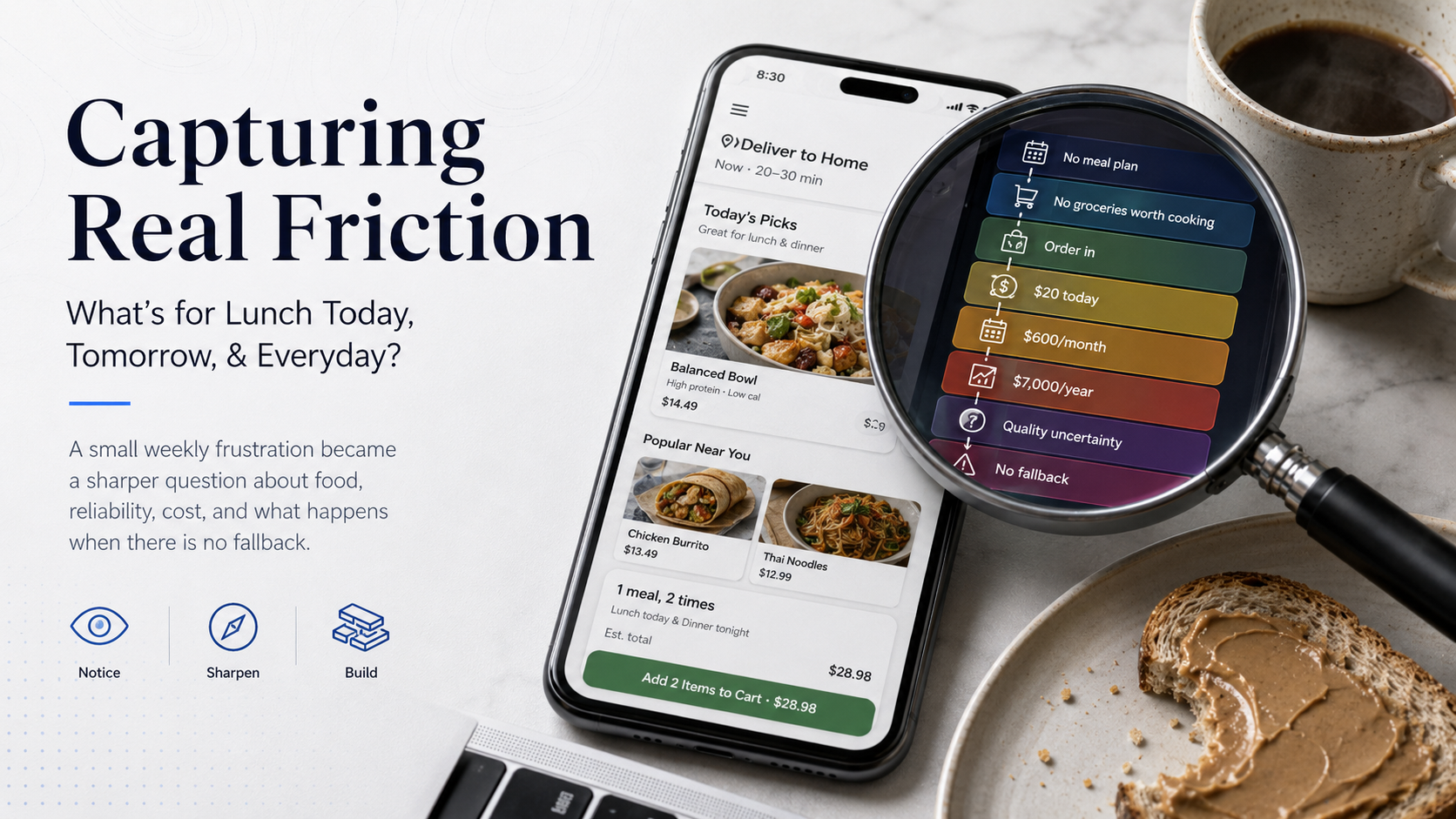
Is there a bigger, more frustrating question I deal with everyday other than "what’s for lunch?"
TEXTReal World Product Innovation · Project: Capture Real Friction
Project
Capturing Real Friction: What's for Lunch Today, Tomorrow, & Everyday for the Rest of My Life?
My first instinct when brainstorming problems/business ideas is always to think of a big, impressive problem. I guess that's how many of our brains are wired... we want to aim for the stars without setting up a telescope first. We want to jump to something that sounds like a startup. Something that would look good on a deck. This project stopped me from doing that.
Instead of brainstorming ideas, I went back through my week and looked for moments that were just unnecessarily hard. Small things, annoying things, things I had already accepted as normal without questioning why. That turned out to be a more interesting exercise than I expected.
Here is what I found.
The Raw List
I started by writing down what actually frustrated me this week, without filtering for what sounded impressive or product-worthy.
I rely on a home cook for my meals during the week. She is great when she shows up. But this week, she did not show up until Friday. Five days of figuring out food on my own, while running a business, while being exhausted by evening. The result: five days of ordering in and watching money disappear.
We do not have in-unit laundry in my building. I keep telling myself I will go downstairs and handle it. I keep not doing it. The threshold for action is apparently owning zero clean underwear.
On days when I spend most of my time alone, working, I notice something strange happens by the time I finally speak to another human. I stumble over words. I mumble. I lose the thread mid-sentence. My usual clarity is just gone.
The Moment I Picked, and Why
All three are real. But the food one lived with me every single day this week. It has financial weight, health implications, and I know from conversations with people I know that it is not just my problem. The laundry problem is real but low-stakes. The speech problem felt too personal to dig into right now.
So I stayed with the food one.
Sharpening the Problem
The specific moment
It is 8:30am on a Tuesday. I just got out of the shower, sat down at the kitchen table, and made myself a piece of toast with peanut butter and a quick Keurig coffee. Basic, but fine. And then, mid-bite, it hits me: I have absolutely no plan for the rest of the day's meals. No groceries worth cooking. No cook coming. A full day of work ahead. I know I am going to order in, and I already feel vaguely terrible about it before I have even opened the app.
The scene
I am still in my kitchen, toast half-eaten, coffee going cold. I open DoorDash and immediately start doing the math in my head. I need something that covers lunch and dinner so I only have to order once. I need it to be from somewhere with a deal so I can pretend I am being responsible about it. I find something, place the order, and close the app.
Then the real spiral begins. $20 today. If this keeps up, that is $600 a month. Over $7,000 a year. On food I did not even particularly want, from restaurants I cannot verify, made with ingredients I know nothing about. I close my phone and stare at the wall for a moment. Then I open my laptop and start working, because what else is there to do.
The frustration
It is not one clean emotion. It is several arriving at once. There is the low-grade dread of realizing the day is already slightly out of my control before 9am. There is genuine financial guilt, not the performative kind, but the kind where you can see the number adding up and you cannot stop it.
And underneath both of those is something closer to helplessness, because I have genuinely thought through the alternatives and none of them work. Cooking is not realistic with my schedule. Cheaper delivery means worse quality, and I care about what I put in my body. Finding a new cook means starting over with someone who does not know my diet, my preferences, or my kitchen. There is no obvious exit.
What broke down
The process broke down first. My entire food system is built around one person showing up on a consistent schedule. When she does not, there is no fallback. Nothing in place for the gap.
The mismatch is that I need good, quality food to be reliably accessible without it demanding time, energy, or a credit card hit I will regret. As for tools, it is not that any tool failed me. It is that cooking requires time and presence I genuinely do not have, which means all the tools in my kitchen might as well be decorative.
What This Problem Is Not
I am not trying to solve for the time or mental barrier of cooking. I know myself well enough to know that is not changing with my current schedule.
I am not looking for cheaper restaurants or a better delivery app. Quality matters to me, and cutting corners on food has costs that do not show up immediately but do show up eventually.
I am not trying to find a different cook. She is excellent, understands my diet, and her pricing is fair. The problem is not her. The problem is the gap she leaves when she does not come.
What surprised me most about this process was how much sharper the problem got each time I pushed it one level further. What started as "I hate not having food at home" ended up being something specific enough to actually think about building on.