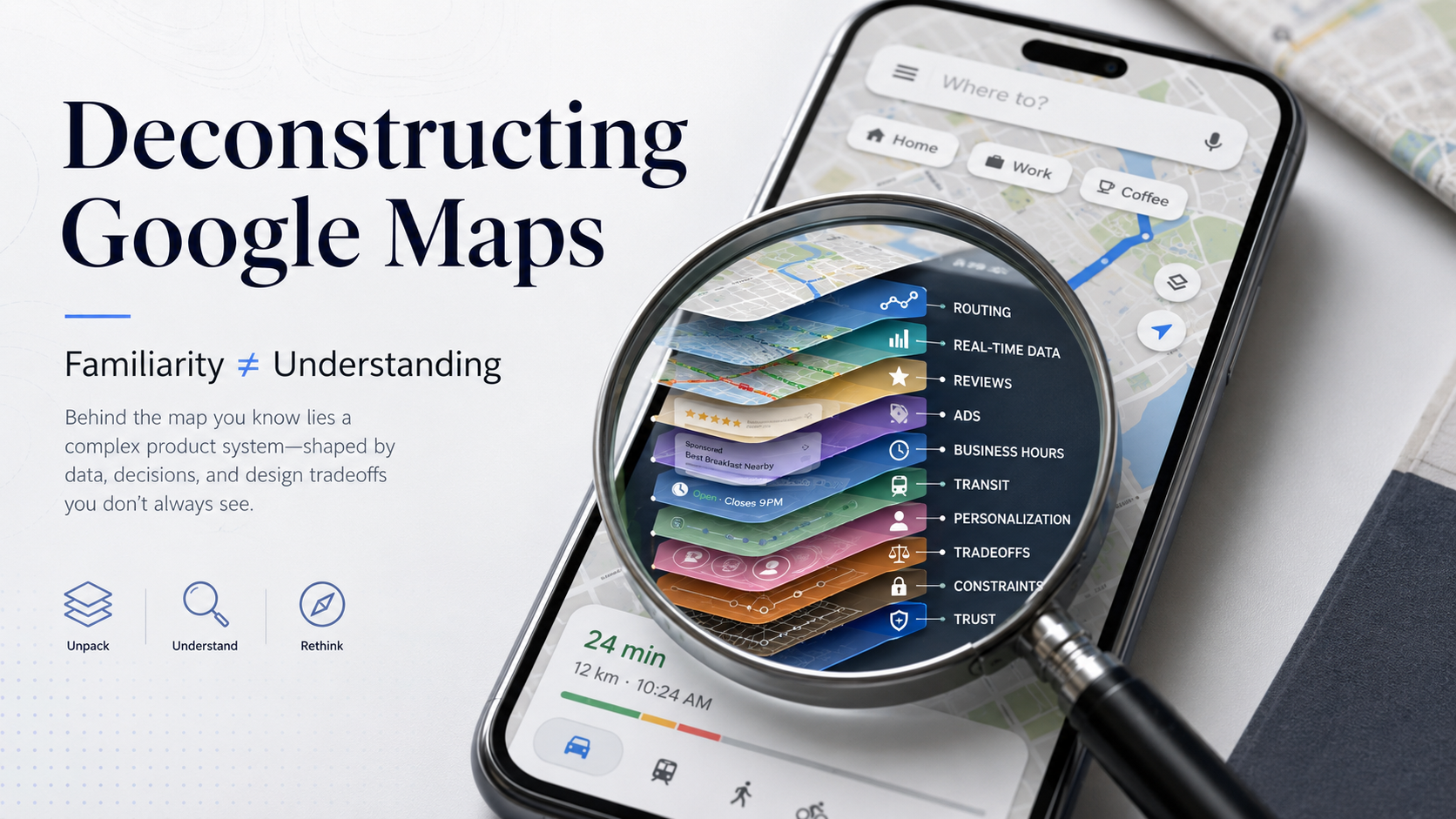
Project 1: Deconstructing Something You Use Everyday
A Product Breakdown of Google Maps
TEXTReal World Product Innovation · Project: Deconstruct Something You Use
Project
Deconstructing Something You Use Everyday: A Product Breakdown of Google Maps
My first Mosaic Minds course, "Real World Product Innovation," opened with a reframe: a product is not an idea, it is a set of decisions made under constraints.
This project is about testing whether I can actually see those decisions in something real. Not critique it, not improve it, but just understand it.
I used Claude to help me structure my thoughts and challenge my beliefs so that I come out of the exercise with a refined understanding of Google Maps and my relationship with it, rather than simply use this project as a Q&A exercise.
Step 1: Identifying and defining the product
Google Maps is a navigation and local discovery tool. You use it to get from one place to another, to choose how to get there, and to decide whether a place is worth going to in the first place. It is the thing you open when you need directions, when you are picking a route home, when you are looking for somewhere to eat nearby, or when you need to know if somewhere is open right now.
Step 2: When do I actually use it?
On foot in an unfamiliar area -- even if the destination is familiar, if my starting point is new, I open Maps. For transit, I use it to figure out which train or bus to take and from where, regardless of how well I know the city. For local discovery, I use it to find restaurants for lunch, coffee spots to meet someone, or places nearby when I do not already have somewhere in mind.
A recent example: I walked from my office to a dinner spot using Maps, then used it again from the restaurant to find the best train home. Two separate navigation decisions in one evening, both handled without thinking.
Step 3: Who was this product designed for?
Google Maps was designed for people who move through environments where the best route is not always obvious, or where it is obvious but worth verifying. That includes drivers checking traffic, urban dwellers choosing between walking, transit, and rideshare, and anyone arriving somewhere unfamiliar. The common thread is not the mode of transport. It is that the person wants the best option confirmed in real time, not just assumed.
Step 4: What problem does it prioritize solving?
Google Maps prioritizes reducing the friction of moving through and making decisions about the real world in real time. That includes routing, but also surfacing whether a place is open, good, and worth the trip. The core problem it solves: you should not have to check five different sources to make a simple decision about where to go or how to get there.
When it fails, the failure is always the same: inaccurate real-time information. Wrong transit timings, unreliable road conditions, incorrect business hours. The failure mode reveals the promise.
Step 5: What is one tradeoff the creator likely made?
Google Maps optimizes for breadth over depth. It does navigation, transit, local discovery, and reviews all in one place, for virtually every city in the world. The tradeoff: it is rarely the best tool for any single one of those jobs. Citymapper is more accurate for transit. Dedicated review platforms are more trusted for restaurants. And the routing engine does not accommodate personal preferences like wanting to walk more before boarding a train.
There are also two subtler tradeoffs buried in the product itself. First, Maps is free because Google monetizes local advertising, meaning businesses can pay for promoted placement, which quietly compromises the neutrality of recommendations. Second, because reviewing is not a core behavior in Maps, only people with extreme experiences tend to leave ratings. The silent majority who had a perfectly fine experience never weigh in. The average rating is not a true average of all experiences. It is an average of the people who felt strongly enough to say something.
What got better:one app handles almost everything, for free, everywhere. What got worse: depth, accuracy, personalization, and the reliability of the recommendations themselves.
Step 6: What did the creator knowingly sacrifice?
Google Maps seems to have knowingly sacrificed pinpoint accuracy of transit modes, neutrality in reviews on the platform, and personalization in order to be the default navigation and discovery tool for the entire world. They accepted that transit timings would sometimes be wrong, that restaurant recommendations would be ad-influenced and review-biased, and that routing would not always accommodate individual preferences. These are not oversights. They are the logical consequence of optimizing for one thing above all else: being the single app a person anywhere on the planet can open and immediately get moving. Going deep on any one feature for any one type of user would mean going shallow somewhere else. Google, as a large organization catering to billions of devices worldwide, made peace with that (knowing they have plenty of cool sub-products or features such as Reviews which would be a logical addition to Maps), and built for everyone instead of a hyper-specific persona.
Conclusion
Going into this, I thought I knew Google Maps well. I use it every day.
But familiarity is not the same as understanding, and working through this breakdown made that gap obvious. Writing it down was what forced the difference. I could not just gesture at an idea and move on. I had to commit to a sentence, and that commitment exposed where my thinking was vague.
A few things I only understood properly once I had written them out:
The failure mode insight: that every time Maps lets me down, it is the same failure. Inaccurate real-time information. I had felt that frustration before but never connected it across contexts.
The two-layer review problem: ad-driven bias and selection bias are separate issues that compound each other. I would not have seen the second one without pushing through the first.
The breadth versus depth tradeoff: I knew Maps was not the best at any one thing, but writing it out made me realize that was a choice, not a limitation.
What surprised me most was how much of what I experience as frustration is not a failure of execution. It is the product working exactly as designed, just not for the specific depth I wanted. That reframe is uncomfortable in a useful way.
It also changed how I look at products generally. The question I keep coming back to now is not "what does this do" but "what did they decide to (and not to) do, and why." That second question turns out to be far more revealing. Every gap in a product is a decision someone made, consciously or not.
As I learn more about product thinking, I am most curious about what it feels like to be on the other side of these decisions. It is easy to deconstruct someone else's tradeoffs in hindsight. It is a different thing entirely to make them yourself, without knowing what will matter later. That is what I want to get better at.