I was making several assumptions about the problem statement, and writing them down was a good exercise in developing clarity about what we are doing here.
TEXTReal World Product Innovation · Project: Name Your Assumption
Project
Name Your Assumption
Every problem statement is built on beliefs. Some are stated explicitly. Most are not. This project is about surfacing the one belief that is doing the most work underneath my problem statement... the one where being wrong would matter most. Before I can test anything, I need to know what I am actually betting on.
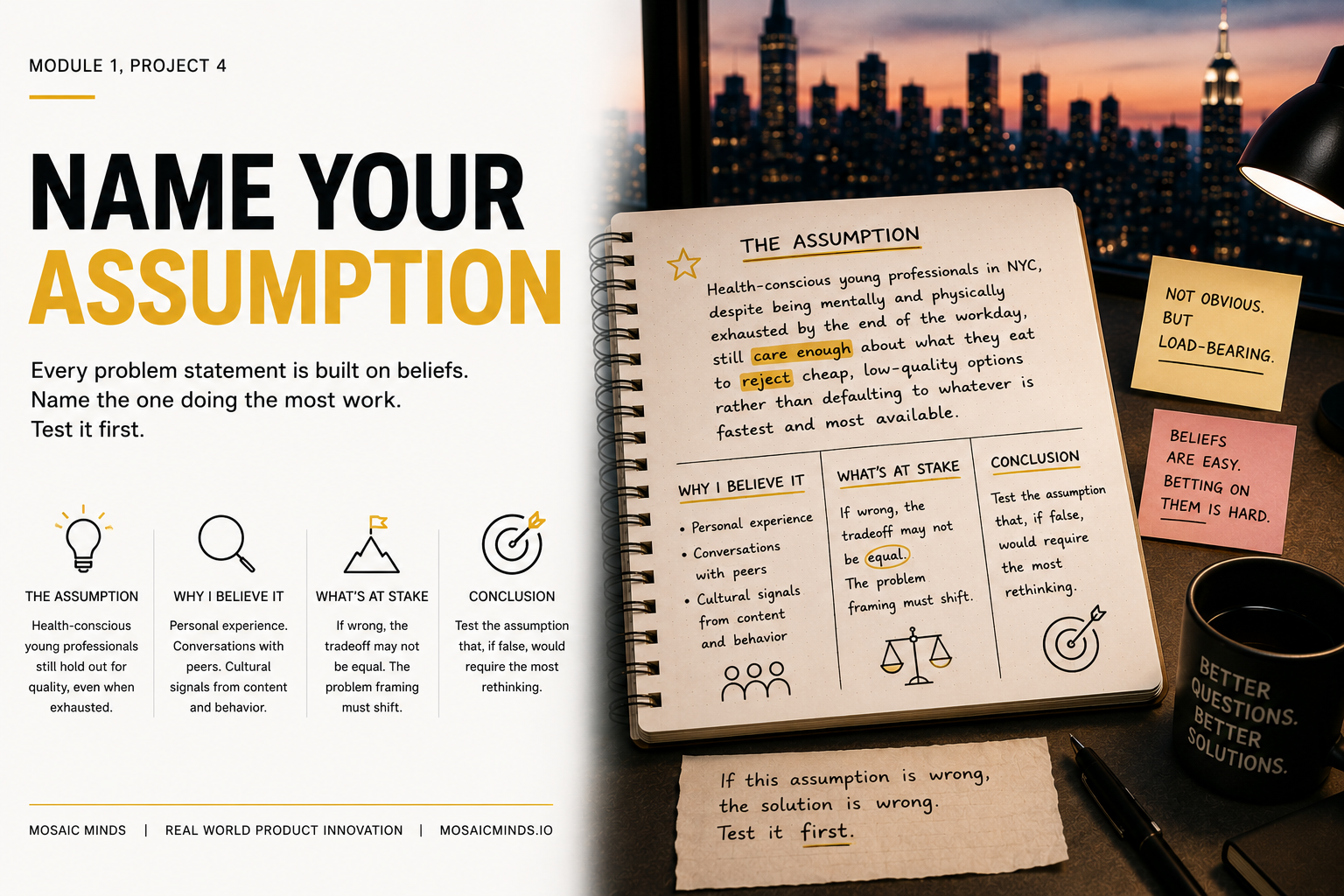
The assumption
Health-conscious young professionals in NYC, despite being mentally and physically exhausted by the end of the workday, still care enough about what they eat to actively reject cheap, low-quality options rather than simply defaulting to whatever is fastest and most available.
Why I believe it
This belief comes from three places.
First, personal experience. As documented in the friction capture and problem definition projects from Module 1, my own food system broke down repeatedly when my home cook did not show up; and even in those moments of exhaustion and convenience pressure, I found myself unwilling to default to cheap, low-quality delivery. The guilt was not just financial. It was about what I was putting in my body.
Second, conversations with peers. Most friends in a similar life stage... mid-twenties, busy, NYC-based... describe a version of the same struggle. Those who get lunch at work still find it hard to eat consistently well there. Those who work from home or do not get office lunch are navigating the same exhaustion-versus-quality tension every evening. The problem comes up constantly, unprompted, across a wide enough range of people that it does not feel like a personal quirk.
Third, cultural signal. The sheer volume of high-performing content on YouTube, TikTok, and Instagram around healthy eating on a budget, quick healthy meals, and "what I eat in a day" from people with demanding schedules suggests that demand is real and widespread. People are actively seeking solutions, which implies they have not given up on the goal even when life makes it hard.
What is at stake
If this assumption turns out to be wrong; if health-conscious young professionals, when exhausted, actually default to whatever is cheapest and fastest rather than holding out for quality; the problem does not disappear, but the framing shifts significantly.
The three-way tradeoff between affordability, health, and ease of access may not be experienced equally. It is possible that at the moment of peak exhaustion, most people are really only optimizing for one of the three, and quietly letting the others go. If that is true, the problem statement needs to be reweighted, and any solution built around all three bars being equally important would miss where the real pain actually lives.
Conclusion
What this project clarified is that naming an assumption is harder than it sounds. The first instinct is to list everything you believe, which is not the same as identifying the one belief that is load-bearing. The assumption I landed on is not the most obvious one in my problem statement. It is the one that, if false, would require the most rethinking. That is the right assumption to test first.