TEXTReal World Product Innovation · Project: Revise Your Problem Statement
Project
Revised Problem Statement
Original statement
Health-conscious young professionals in NYC end every long workday facing the same impossible tradeoff: eat affordably and sacrifice quality, eat well and strain the budget, or cook when there is nothing left in the tank. No existing option clears all three bars at once, and the cost compounds daily. This problem does not include people willing to cook or those for whom food quality is negotiable.
What changed
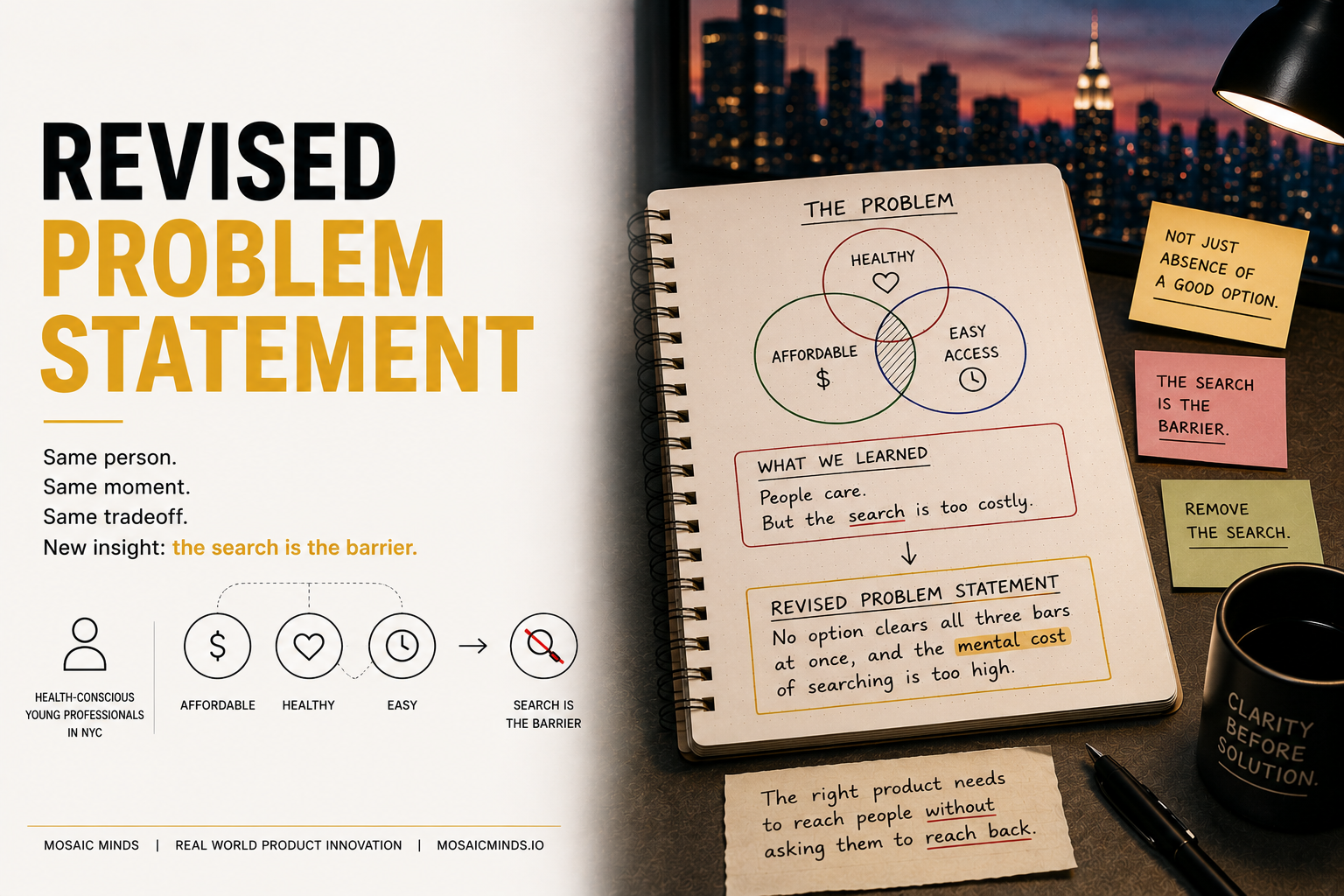
The signal confirmed the core framing but added an important layer. The original statement describes the tradeoff accurately, but it implies that the barrier is simply the absence of a good option. What 15 conversations with friends and colleagues revealed is that there is a second barrier sitting on top of the first: even people who care enough to want all three bars cleared will not go looking for a better option if the search itself requires energy they do not have by the end of the day.
The problem is not just that no option clears all three bars. It is that the mental cost of searching for such an option is high enough that most people absorb the tradeoff rather than fight it. They default not because they have stopped caring, but because the act of looking is itself another tax on a day that has already taken everything. Any solution that requires evaluation effort, however good it actually is, will face the same resistance as every current option.
That distinction changes what a solution needs to do. It is not enough to exist. It has to remove the search entirely.
What stayed the same
The user is confirmed. The moment is confirmed. The three-way tradeoff between affordability, health, and ease is confirmed. The compounding cost across the week is confirmed. The boundary around people willing to cook or indifferent to food quality is confirmed.
A small number of people in the conversations fell entirely outside the problem: they cook without friction, or food simply does not register as a stressor. They are not the user, and their exclusion from the problem statement remains correct.
Revised statement
Health-conscious young professionals in NYC end every long workday facing the same impossible tradeoff: eat affordably and sacrifice quality, eat well and strain the budget, or cook when there is nothing left in the tank.
No existing option clears all three bars at once; and the mental cost of searching for one is high enough that most people default to the path of least resistance rather than look. The cost compounds daily.
This problem doesnot include people willing to cook or those for whom food quality is negotiable.
Conclusion
The revision is one sentence. That might seem like a small return on fifteen conversations. It is not. That sentence changes the design requirement.
The original statement implied that the right product just needs to exist and be good. The revised statement implies something harder: the right product needs to reach people without asking them to reach back. Passive discovery, not active search.
That is a meaningful constraint to carry into Module 3, and it came entirely from getting outside my own head.