I wish I could stop stressing out about food... but it feels like every living moment I spend not working is dedicated towards figuring out what I am going to eat for the next meal!
TEXTReal World Product Innovation · Project: Define Your Problem
Project
Define Your Problem
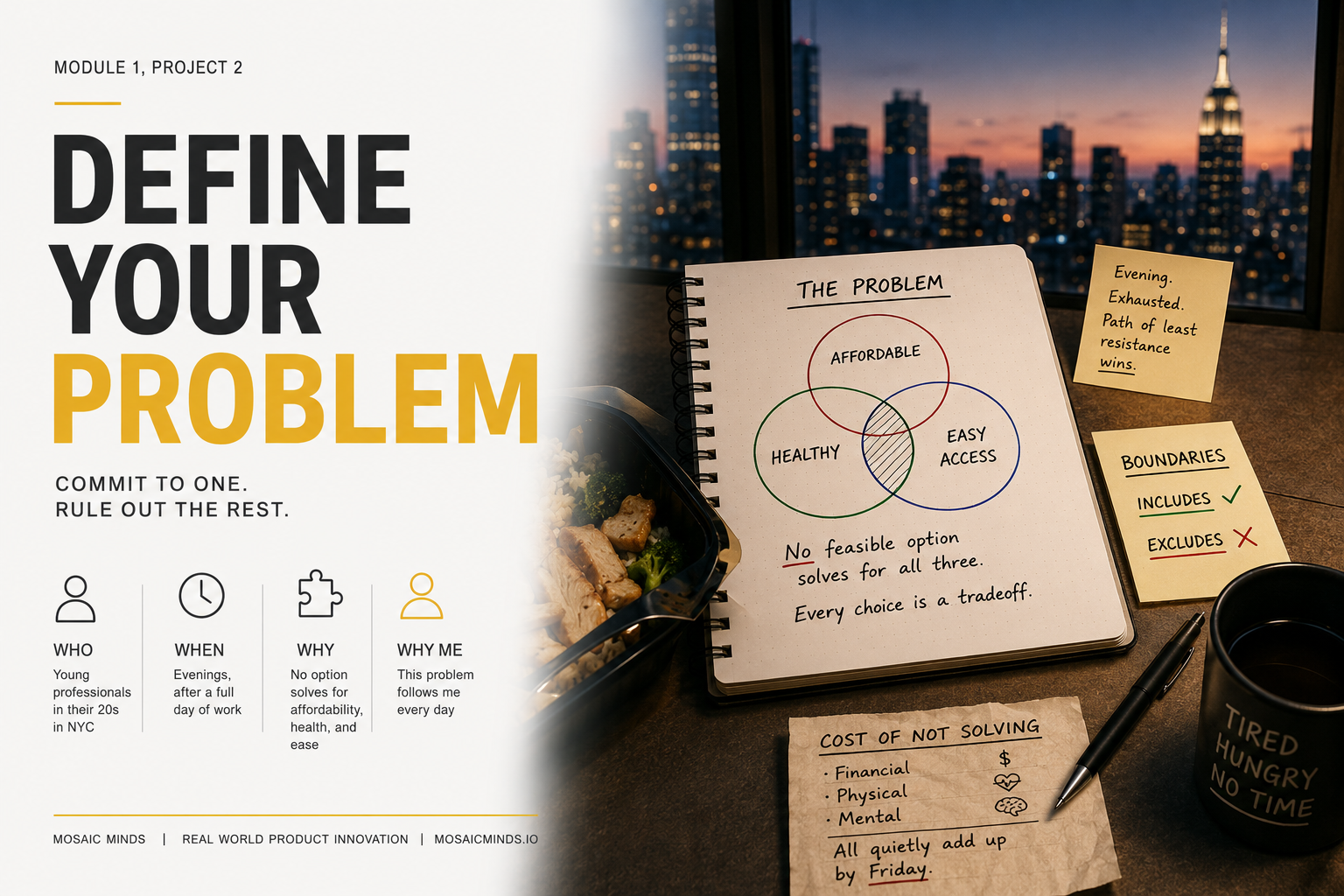
The previous project asked me to observe without filtering; to write down real friction before deciding whether it was worth anything. This one asks something harder: to commit. To pick one problem, name exactly who has it and when and why, and draw a clear line around what it is and is not. Committing to one thing means ruling out everything else. That turns out to be the difficult part. Here is my attempt at building from scratch with these questions in mind:
Who?
Young professionals in their twenties in NYC... fresh into their careers, working long hours, and trying to be intentional about their health. They are not people who have given up on eating well. They are people who care about what they put in their body but have neither the time nor the energy to act on that care consistently.
When?
The problem hits hardest in the evening, after a full day of work, when mental and physical exhaustion makes both cooking and deciding what to order feel like tasks that require more than what is left in the tank. By that point, the path of least resistance wins, and the path of least resistance is almost never the healthy, affordable option.
Why?
Because there is no feasible option that solves for all three things at once: affordability, health, and ease of access. Every available option forces a tradeoff. Cheap and fast sacrifices health. Healthy and fast sacrifices budget. Cheap and healthy requires time and energy that simply are not there. The result is a problem that compounds across the week; each evening of not solving it makes the next morning harder, which makes the next evening worse. By Friday, the financial, physical, and mental costs have all quietly added up.
Why me?
Because this problem follows me every single day. It is not abstract. It shows up as low-grade anxiety about my health when I have ordered in four nights in a row. It shows up as guilt when I see the weekly total on my delivery apps. It shows up as exhaustion at the thought of solving it when I already have nothing left. I am staying with this problem because I cannot escape it, and that kind of daily friction is exactly the kind worth understanding deeply.
Drawing boundaries
This problem includes: the daily decision-making burden around food, the compounding cost of eating well without cooking, and the structural gap that makes affordability, health, and ease of access mutually exclusive for this specific person in this specific moment.
This problem does NOT include: solving for people who have the time or inclination to cook, finding cheaper food regardless of nutritional quality, or building a habit-change or meal-planning product that requires sustained mental effort to use.
Conclusion
What surprised me about this project was how much resistance I felt toward the boundary step. Drawing boundaries feels like giving something up, like you are voluntarily making your problem smaller. But the opposite is true. A problem without boundaries is not a big problem. It is an unexamined one.
The boundaries are what make it specific enough to test, specific enough to build on, and specific enough to be honest about.
The other thing this project clarified: the "why me" question is not about passion or interest. It is about proximity. I am staying with this problem because I live inside it every day. That is not inspiration... it is accountability. And accountability, to me, is a better reason to stay with a problem than enthusiasm.