It feels good to have your ideas validated, and even better to have them challenged!
TEXTReal World Product Innovation · Project: Go Find a Signal
Project
Finding a Signal
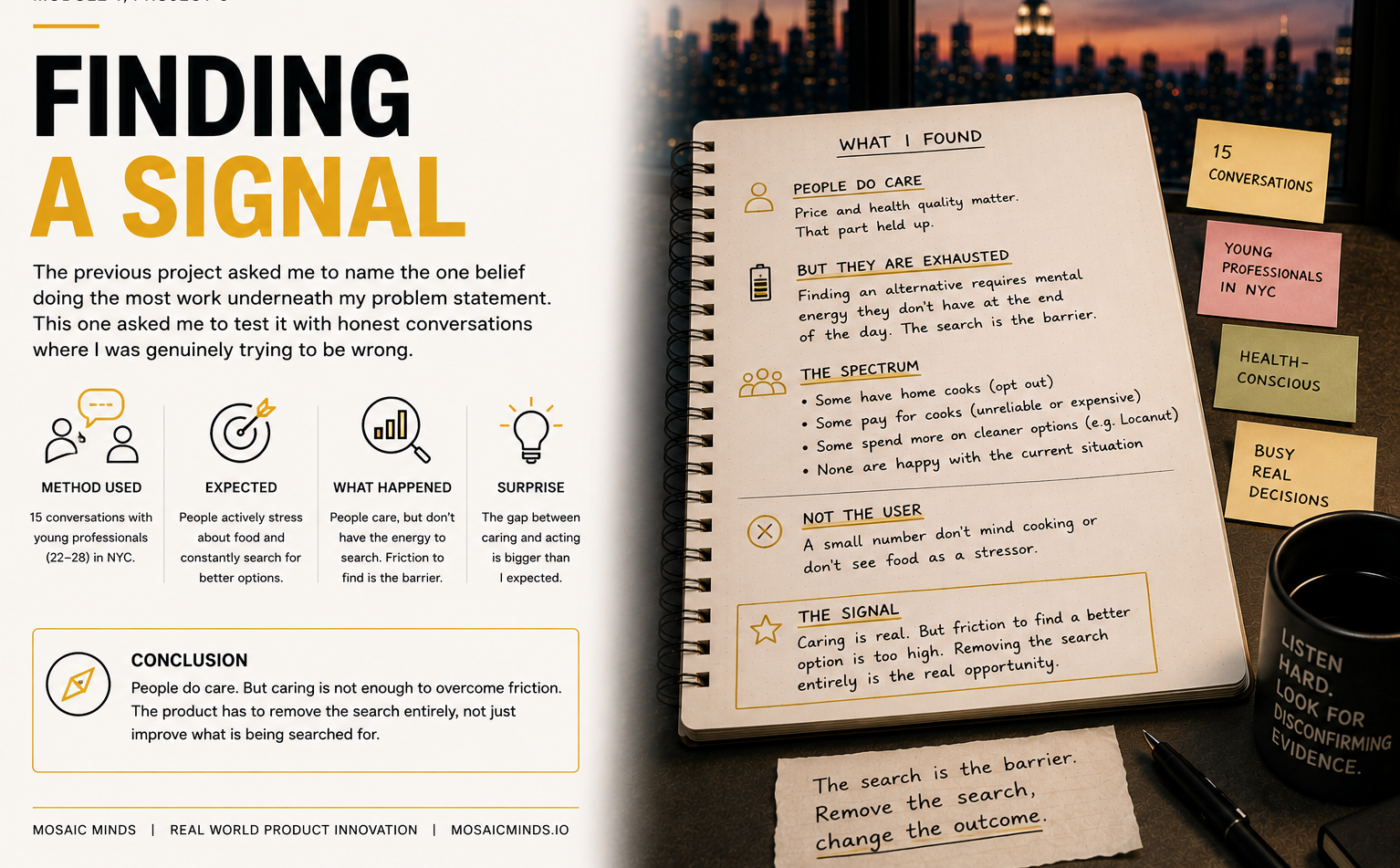
The previous project asked me to name the one belief doing the most work underneath my problem statement. This one asked me to test it with honest conversations where I was genuinely trying to be wrong or listen with an open mind. Here is what I found:
Method used
Short conversations with 15 people between the ages of 22 and 28... friends and colleagues who fit the user profile: young professionals in NYC, health-conscious, busy, navigating food decisions largely on their own. No surveys. No pitching. Just asking about their experience.
What I expected
I expected everyone to stress about food as actively and consciously as I do. I expected to hear that people were constantly frustrated, constantly searching for better options, constantly rejecting the default because it did not meet their standards.
What actually happened
The reality was more nuanced. People do worry about the price and health quality of what they eat. That part held up. But the worry does not translate into active searching. Most people default to cheap, less healthy options not because they have stopped caring, but because finding an alternative requires mental energy they do not have left by the end of the day. The friction of searching is itself a barrier.
The specifics varied across the 15 conversations. A few have reliable home cooks and largely opt out of the problem. Several others pay for cooks but deal with either unreliability or costs that are hard to justify consistently. Some spend more deliberately on cleaner options like Locanut, knowing it is not the cheapest choice. But none of them described their current situation as something they were happy with. They are doing what they do because no clean, pocket-friendly, accessible alternative exists, not because they have found a solution.
A small number fell outside the problem entirely. They do not mind cooking, or food is simply not a stressor for them. They are not the user.
What surprised me
Nothing was a complete contradiction. But the gap between caring and acting was sharper than I expected. I had assumed that people who care about health would be actively resisting the default. What I actually heard is that the resistance exists but collapses under the weight of everything else. The stressor is real. The desire for a better option is real. But the search for that option is itself stressful enough that most people absorb the cost of the default rather than bear the cost of looking.
That is a meaningful distinction. It changes what a solution needs to do.
Conclusion
The signal confirmed the assumption but complicated it.
People do care. But caring is not enough to overcome friction. Any solution that requires effort to find or evaluate, even if the solution itself is excellent, will face the same resistance that every current option faces.
The product has to remove the search entirely, not just improve what is being searched for. That is the real insight from this round of signal gathering, and it is sharp enough to change how I think about what comes next.